
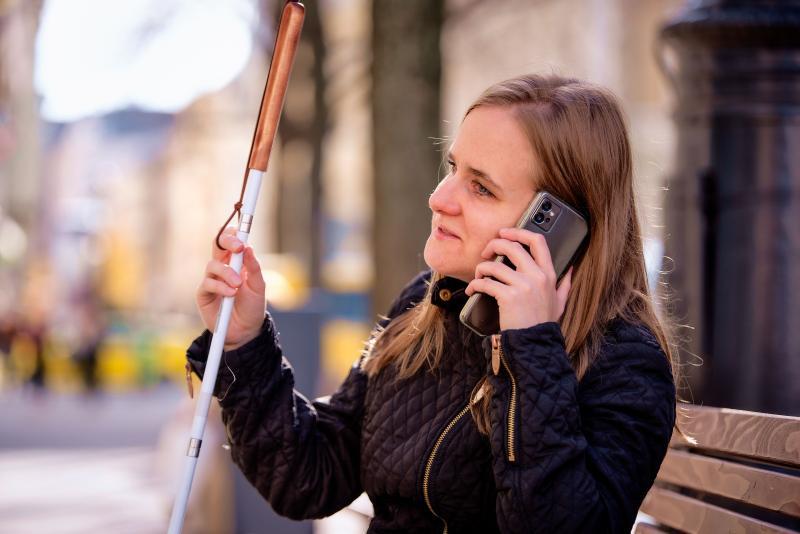
These resources were developed from NRTC research on assistive technology (AT) use in the workplace by people who are blind or have low vision (B/LV). Some resources, like the final report, are for a general audience, and others were designed for specific audiences, such as AT instructors, other professionals, or individuals who are B/LV.
AT in the Workplace Study Final Report
This report presents findings from the NRTC’s five-year longitudinal study of AT use in the workplace by people who are B/LV, covering which technologies workers use, how they use them, how AT use has changed over time, and the challenges they face.
NRTC AT Study Final Report 2026
AT Study – Highlights for Professionals
A concise summary of key findings from the AT in the Workplace study, designed for VR professionals and AT specialists
NRTC AT Study- Highlights for Professionals
Checklist for Teaching Exploration & Troubleshooting
A practical checklist to guide AT specialists in teaching clients AT skills, including strategies for exploration and troubleshooting problems
Checklist for Teaching Exploration Troubleshooting
Fact Sheet – AT in the Workplace Study
This fact sheet presents key findings and practical takeaways from the AT in the Workplace study for people who are B/LV, covering AT skills needed for work, use of braille devices and apps, common workplace challenges, and training recommendations.
Fact Sheet - AT in the Workplace Study
Tip Sheet – Accessibility Workarounds for B/LV People
This tip sheet shares workaround strategies recommended by B/LV workers for dealing with inaccessible digital documents, inaccessible software, and PDF signature challenges, drawn directly from AT in the Workplace study participants.
Tip Sheet - Accessibility Workarounds
Course - AT in the Workplace for Individuals Who Are Blind or Have Low Vision
This course provides an overview of assistive technology (AT) use in the workplace for individuals who are blind or have low vision. Grounded in a national research study, it translates findings into practical insights for service providers and professionals in this field. Available for 1.5 CRC, ACVREP, and NBPCB credit.
Access the Course Assistive Technology in the Workplace Course Link.
Supporting Workplace Success: Addressing Barriers to AT Use for People Who Are B/LV
Brief summary of key AT in the Workplace study findings, along with implications and resources for employers, professionals, and people who are B/LV (created by the Knowledge Translation for Employment Research Center)
Supporting Workplace Success: Addressing Barriers to AT Use for People Who Are B/LV
Infographic – Who has proficient braille skills?
A summary of the results from a study published in the Journal of Visual Impairment & Blindness
Infographic - Who has proficient braille skills?
AccessWorld Publications
McDonnall, M. (2025, Winter). Change in assistive technology use at work between 2021 and 2024. AccessWorld. https://afb.org/aw/winter2025/2021-2024-change-AT-usage
McDonnall, M. (2024, Fall). Remote sighted assistance app use and thoughts about “sighted” assistance from artificial intelligence. AccessWorld. https://www.afb.org/aw/fall2024/ai-usage-research
McDonnall, M. C. (2023, Summer). Challenges with AT in the workplace: Accessibility issues top the list. AccessWorld. https://www.afb.org/aw/24/6/1836
McDonnall, M. & Steverson, A. (2023, Spring). Interest in and adoption of novel AT: Findings from the NRTC’s AT in the Workplace study. AccessWorld. https://www.afb.org/aw/24/5/18311
Steverson, A., McDonnall, M., & Sergi, K. (2022, May). What assistive technologies are used in the workplace? Initial research findings by NRTC on Blindness and Low Vision, Mississippi State University. AccessWorld. https://www.afb.org/aw/23/5/17939
Peer-reviewed Publications
McDonnall, M. C., Boydstun, J., & Steverson, A. (2026). Advantages of using refreshable braille devices at work. The New Re:View, 4(2), 84-89.
McDonnall, M. C., Boydstun, J., & Steverson, A. (2026). Use of wearable devices and generative AI in the workplace by people with visual impairments. Journal of Visual Impairment & Blindness, 120(2), 134-148.
McDonnall, M. C., Boydstun, J., & Steverson, A. (2025). Is one enough? Screen reader use among employed people who are blind or have low vision in the U.S. Disability and Rehabilitation: Assistive Technology. Advance online publication.
McDonnall, M. C., & Sessler Trinkowsky, R. (2025). Assistive technology innovations: Perceptions, adoption, and desires. Assistive Technology Outcomes and Benefits, 19, 47-66.
McDonnall, M.C., Steverson, A., Boydstun, J., & D’Andrea, F.M. (2025). Factors associated with proficient braille skills in adults. Journal of Visual Impairment & Blindness, 111(2), 97-108.
McDonnall, M. C., Steverson, A., Trinkowsky, R. S., & Sergi, K. (2024). Assistive technology use in the workplace by people with blindness and low vision: Perceived skill level, satisfaction, and challenges. Assistive Technology, 36(6), 429-436.
Boydstun, J., McDonnall, M. C., & Steverson, A. (2024). Assistive technology in the workplace and training needs: Insights from employed young adults who are blind or have low vision. Visual Impairment and Deafblind Education Quarterly, 69(4), 79-96.
McDonnall, M. C., Sessler-Trinkowsky, R., & Steverson, A. (2024). Use of braille in the workplace by people who are blind. Journal on Technology and Persons with Disabilities, 12, 58-75.
McDonnall, M. C., Steverson, A., & Boydstun, J. (2024). Actual and preferred methods for learning to use assistive technology. Assistive Technology Outcomes and Benefits, 18, 20-35.
McDonnall, M. C., Sergi, K., & Steverson, A. (2023). Comparison of assistive technology use and beliefs among employed and unemployed people who are blind. The New RE:View, 1(2), 12-27.