
New Assistive Technology Resources Put Research into Practice
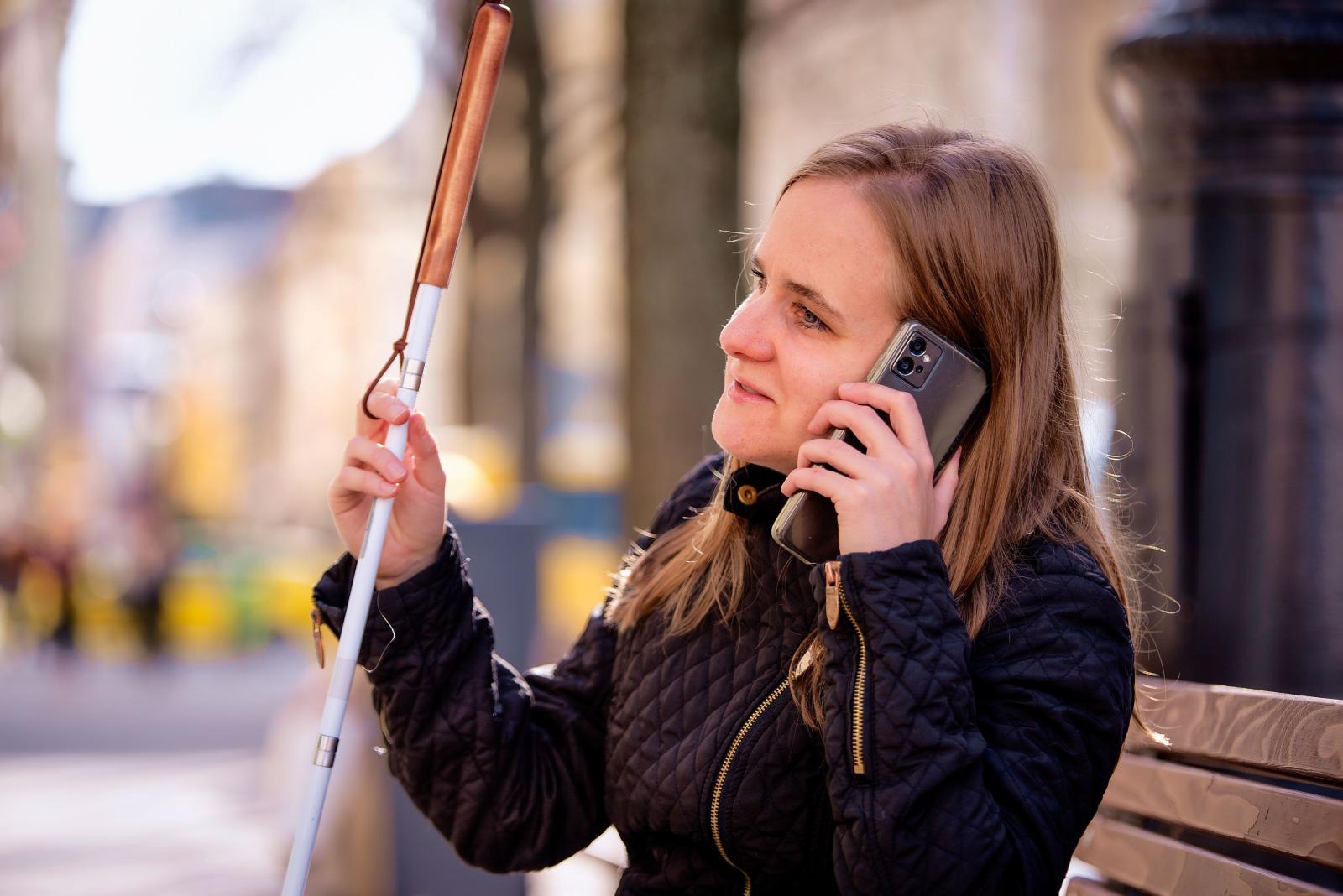
Using assistive technology (AT) successfully in the workplace involves more than knowing how to use a particular device or program. Workers also need strategies for troubleshooting problems, adapting to technology changes, and navigating accessibility barriers.
We created a new Assistive Technology-Related Resources webpage that brings together practical, research-based tools. These resources grew out of our AT in the Workplace study, which examined AT use by workers who are blind or have low vision (B/LV) and challenges experienced with AT use on the job.
The resources are designed for multiple audiences, including AT instructors, rehabilitation professionals, people who are B/LV, and others who support their employment and technology needs.
Explore some of the newest resources:
- Assistive Technology in the Workplace Online Course: This 1.5-hour course provides insights from our AT study, including how professionals can put the findings into practice. CEUs are available.
- Checklist for Teaching Exploration & Troubleshooting: A tool for AT instructors to help ensure the exploration and troubleshooting skills students need to navigate changing technology and solve problems independently are covered during training.
- AT Study: Highlights for Professionals: An easy-to-use summary of key findings from NRTC's research on assistive technology and employment.
- Accessibility Workarounds Recommended by Blind and Low Vision Workers: Practical strategies shared by B/LV workers for navigating accessibility barriers in the workplace.
We will soon be adding new fact sheets that identify the core technology skills needed by screen reader users in the workplace, based on our current Identifying and Measuring Core Technology Skills study, described below.
Current Research Highlight: Identifying and Measuring Core Technology Skills
In today’s workplace, technology skills are essential, especially for those who are blind or low vision (B/LV), as they rely on screen readers and other AT to participate in the workforce. Digital proficiency is critical for employment across a wide range of occupations, but there is no accepted set of core technology skills that screen reader users need for employment, nor is there a standardized means of evaluating whether they possess the technological skills needed to enter the workforce successfully. This makes it challenging for vocational rehabilitation professionals, educators, and individuals who are B/LV to prepare for workplace demands.
To address this gap, the NRTC is conducting a research project to identify the core technology skills most important for screen reader users and to develop an objective assessment of those skills. This project will establish expert consensus on the technology skills that underpin workplace success, and the results will be used to develop an objective technology skills assessment.
The research team includes Dr. Michele McDonnall and Dr. Rachael Sessler Trinkowsky, a CATIS with many years of experience teaching AT skills. To date, the team has completed the first phase of the project: a Delphi study to establish expert consensus on the core technology skills needed by screen reader users in the workplace. Twenty-two experts (AT instructors and long-term employed screen reader users) participated in the study, which consisted of four rounds of surveys. In rounds 1-3, the panel came to consensus on 347 core technology skills across 24 skill categories, plus 5 prerequisite skills.
The fourth round survey sought to establish a scaffolding for teaching the core skills, with participants indicating the order in the learning process (e.g., beginning, early, middle or later) that the skills should be taught. Based on the results of the Delphi study, the researchers created a fact sheet for consumers listing all the core technology skills identified in the study, and a resource for professionals that identifies those skills and provides additional details. These resources will be published soon.
The next step of the project is developing items to accurately assess the core skills, which will be used in the objective assessment. Once the items are developed, they will be pilot-tested by AT instructors. Following revisions, the research team will proceed with content validation and field testing to evaluate the assessment’s functionality and to help ensure that the final assessment measures skills accurately and aligns with real-world demands for technology proficiency. The findings of this study will greatly advance knowledge about the core technology skills needed for screen reader users to participate in the workforce, and ultimately result in an objective assessment of those skills. For more information about this research project, see the project page.
Training and Technical Assistance
Discover Our Newest Courses
We’ve released three new courses for service providers and other professionals:
Adjusting to Vision Loss: What Vocational Rehabilitation Professionals Need to Know:This course provides vocational rehabilitation (VR) counselors with a practical, policy-aligned framework for understanding and supporting clients with B/LV as they adjust to vision loss. Available for 1.25 CRC, ACVREP, and NBPCB credit.
Making Sense of Employment Statistics: This course is designed for VR counselors and other service providers who support people with B/LV. Using findings from our 5-year research project, it translates national data into practical insights about employment. Available for 1.5 CRC, ACVREP, and NBPCB credit.
Why Are People With Visual Impairments Not Working? Learn more about the reasons people are not working and what we can do to help them return to the labor force, based on results from our research project. Available for 1 CRC, ACVREP, and NBPCB credit.
Access more courses through our learning management system.
Explore our Latest Resources on Employment
Build Resume Skills for B/LV Job Seekers
Our latest resource, Resume Toolkit for Blind and Low Vision Job Seekers, will help job seekers who are B/LV create resumes that pass ATS software and make a strong impression on hiring managers.
Resume Toolkit for Blind and Low Vision Job Seekers
Accessibility Resources for Communications Professionals
Creating accessible content helps ensure everyone can access and engage with your information, including people who B/LV and those who use assistive technology. These resources were developed specifically for communications professionals and offer practical guidance for creating accessible emails, websites, social media content, documents, graphics, videos, and other digital communications.
- Accessibility Basics for Communications Professionals is a practical guide that explains key accessibility concepts, including formatting, plain language, alt text, captions, and accessibility best practices for common communication tools and platforms.
- Accessibility Checklist for Communications Professionals is a quick-reference tool that serves as a reminder for users about these accessibility considerations before publication.
Other NRTC News
NRTC & OIB-TAC Share About AT Skills and Independence at MAER
The NRTC recently traveled to Jackson, Mississippi, to attend the 2026 Mississippi Chapter of the Association for Education & Rehabilitation (MAER) Annual Conference from September 17 to 19, 2026. Read our news item to learn more.
Advisory Board Spotlight: Q&A with Arielle Silverman

This fall, we're highlighting NRTC Advisory Council member Arielle Silverman, PhD. We asked Arielle about employment, technology, AI, and how research can help improve employment experiences for people who are blind or have low vision.
NRTC: Your research at AFB covers several areas that are important to people who are blind or have low vision, including employment and technology. What are some of the biggest employment challenges you are seeing right now?
Arielle Silverman: I think many of the employment challenges have been similar across time. Employer misconceptions and fears about hiring someone who is BLV remain a huge problem. BLV job candidates are also often under-prepared for the workforce due to education and training gaps. Many entry-level job sectors (such as food service) are inaccessible or unwelcoming to BLV youth, so it is difficult to build basic job skills and experience early in one’s working life. Then, new technologies can solve some problems while introducing others. At AFB, we have focused recently on how technology can both help and harm access in the workplace.
NRTC: NRTC and AFB both conduct research focused on improving employment experiences and outcomes for people who are blind or have low vision. How do you think research can be used to make a difference in what happens in the workplace?
Arielle Silverman: Research is important when it tells a story, either by showing the prevalence and nature of a problem affecting a group of people (quantitative research) or when it synthesizes direct quotations from affected people (qualitative research). Research-based recommendations can help employers understand the problems and potential solutions. Research can also be shared with policymakers to advocate for legislation or regulations that would create equal opportunities.
“At AFB, we have focused recently on how technology can both
help and harm access in the workplace.”
NRTC: What has your research shown about the role technology plays in the employment experiences of people who are blind or have low vision? Are there findings that you think are especially important for professionals in the field to know?
Arielle Silverman: AFB’s 2021 Workplace Technology Study (WTS) showed that technology is integral in the workforce for all employees, not just BLV employees. When systems for job applications, onboarding processes, or on-the-job technologies don’t work well with the assistive tech that BLV employees use for access, the consequences can affect job attainment and retention, and the employee’s sense of belonging in the workplace. On the other hand, accessible technology can help facilitate access to print and other information needed for full inclusion in the workplace. Our more recent research demonstrated that automated hiring assessments are becoming more common, and at least in a minority of cases, the assessments conflicted with screen readers and BLV applicants could not complete them without human assistance or specialized tools. Although BLV employees are entitled to receive reasonable accommodations in the hiring process, automated assessment processes make it harder to figure out how to request reasonable accommodations. Our AI research also showed that BLV employees are increasingly using AI tools at work, just like sighted employees, but also for assistive purposes like reformatting documents and converting print into accessible text.
“It is likely that AI literacy will become necessary to be competitively employed.”
NRTC: You have been involved in recent AFB research looking at artificial intelligence and employment for people with disabilities. As AI becomes more common in hiring and in the workplace, what do you think professionals in our field should be paying attention to?
Arielle Silverman: It is likely that AI literacy will become necessary to be competitively employed. Professionals should consider how AI training should be incorporated into the workplace readiness training provided to BLV individuals. This AI literacy training should also provide balanced information about the limitations of AI tools, such as potential hallucinations. Additionally, service providers should be aware that automated applicant tracking systems, tests, and interviews are becoming more routine in the hiring process, so BLV job-seekers should be trained in how to format their resume and cover letter for AI screening, how to request reasonable accommodations for an inaccessible assessment, etc.
“I think much of the unemployment and workforce non-participation by BLV individuals is preventable if we make employment more accessible.”
NRTC: On a more personal note, what led you to a career in research and the blindness field, and what do you enjoy most about the work you do?
Arielle Silverman: I have been blind since birth, and from an early age I was sensitive to others’ misconceptions about blindness. I earned a scholarship from the National Federation of the Blind (NFB) when I was a new college freshman and I joined the organization that year, getting involved in collective advocacy with other BLV people. Although I always had a scientific mind, I switched my focus from biology to psychology because I wanted to use research to understand and eliminate negative public attitudes about blindness. I have a specific passion related to employment because I think much of the unemployment and workforce non-participation by BLV individuals is preventable if we make employment more accessible. I obtained a Ph.D. in social psychology in 2014 and worked as a contractor for several research institutes (including the NRTC) before coming to AFB full-time in 2021. I love the work I do because I like being able to write up and present our research findings directly to the people who can put them into action.
To learn more about Arielle Silverman, the American Foundation for the Blind (AFB), and the resources available through AFB, please visit AFB.org.
Publications, Presentations, and Miscellanies
Publications
McDonnall, M. C., Antonelli, K., & Marett, E. G. (2026). Providing exposure and education about blindness and low vision: An in-person meeting versus an interactive video. Journal of Rehabilitation, 92(1), 38-47.
Crudden, A., Steverson, A., & Cmar, J. L. (2026). Mental health among people with visual impairments: Are we paying attention? Journal of Visual Impairment & Blindness. Advance online publication.
Upcoming Presentations
McDonnall, M., Boydstun, J., Welch-Grenier, S. (October 2026). Seeing the big picture on employment: Evidence-based resources for youth. APH Annual Meeting 2026. Louisville, KY.
Farrow, K. (2026, November 5). Leveraging older blind services to maximize VR program efficiency. National Council of State Agencies for the Blind (NCSAB) Fall Conference. Frisco, TX.
Welch-Grenier, S. (October 2026). 4to24 in practice: A tool for empowering parents and students. COSB Leadership Institute 2026. Louisville, KY.
Webinars
October 17 (2:00 pm CDT) – Recognizing Elder Abuse: Signs, Resources, and Next Steps
Older adults who are blind or have low vision may be at increased risk of abuse, neglect, exploitation, and self-neglect. Join Jennifer Spoeri, Executive Director of the National Adult Protective Services Association, to learn how to recognize warning signs, understand reporting responsibilities, access resources, and support at-risk older adults.
Available for 1 ACVREP credit. To learn more and register, visit our event page.